This week’s task was to experience different opportunities of creating art in virtual environments. In the lab, people split into groups to experience the VR software. I couldn’t make it in for the lab so I had to schedule a catchup session later on, this meant however that I was doing this week’s content alone rather than passing the VR headset among a group.
All three of these software exploit the nature of VR and expand the creative design process into the third dimension so that the user can truly have an immersive experience.
_______________________________________________________________________________________________________
Open Brush
_______________________________________________________________________________________________________
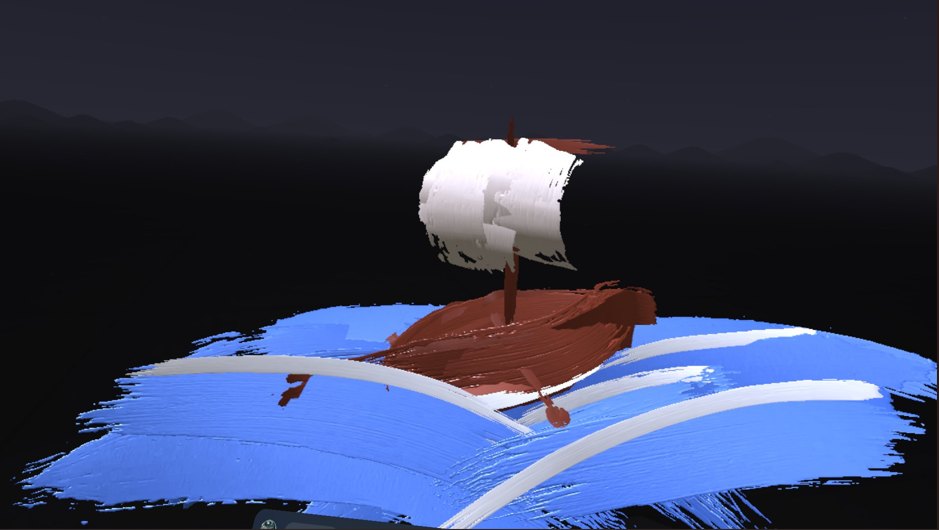
The first app I tried out was Open Brush, a room-scale 3D freeform painting application. From my short exposure to the app I found that the control scheme was very intuitive which enhanced my experience. Despite having no experience in VR I was able to easily test different visual elements within the software from all angles, such as colour, texture and perspective.
I tried to arrange a simple scene which could take advantage of the spatial nature of Open Brush, I could draw with my arm’s full range of movement and had a very wide selection of brushes and effects I could pick from.
_______________________________________________________________________________________________________
ShapesXR
_______________________________________________________________________________________________________
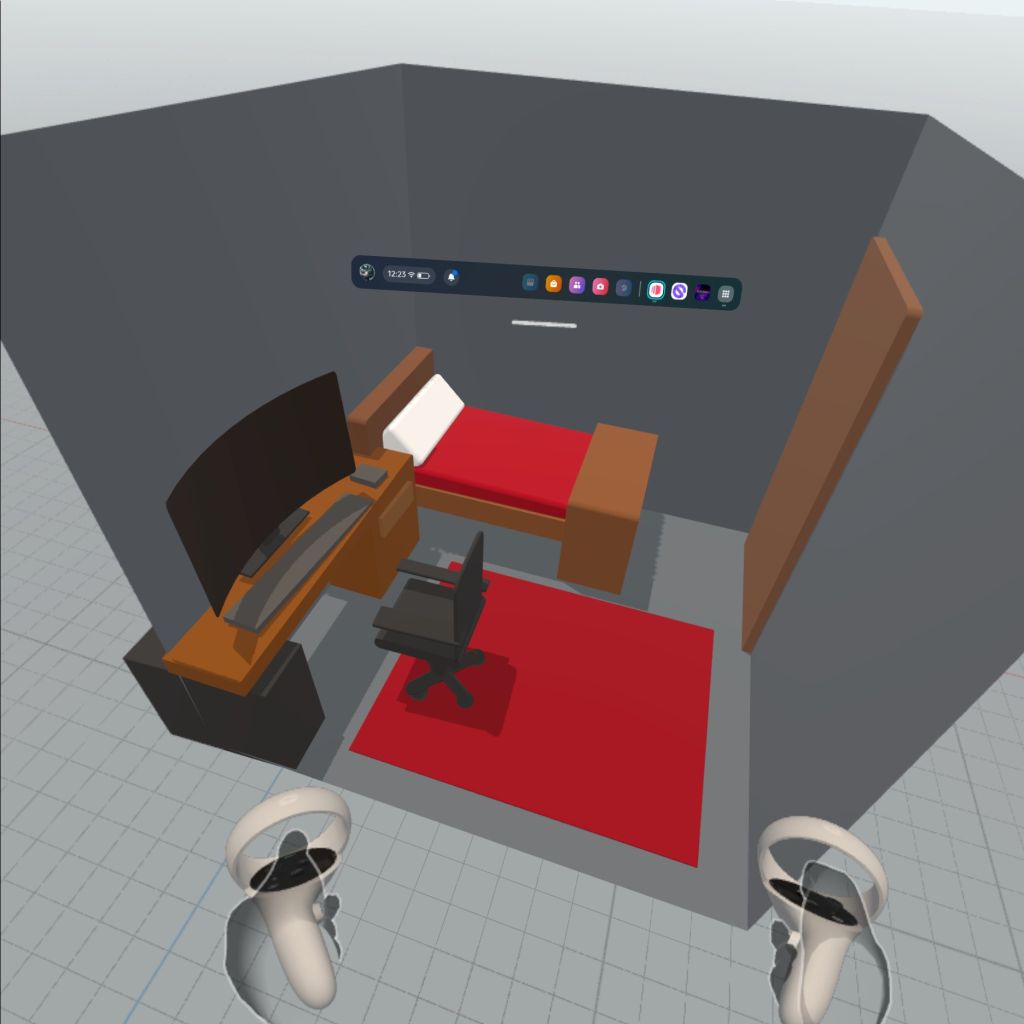
In ShapesXR I created a small block-out of a bedroom. Unlike Open Brush this software felt more suited for fast iterative prototyping of models or environments due to the way the interface was presented. I found that my initial experience with the app wasn’t as intuitive as Open Brush had been but I got used to the controls rather quickly.
The software had a smaller selection of freehand brushes and effects but rather focused on shape insertion, allowing me to quickly place a primitive shape into the scene in the exact place I wanted it and then further tweak it, adjusting the colour or fine tuning the shape and position.
_______________________________________________________________________________________________________
Gravity Sketch
_______________________________________________________________________________________________________
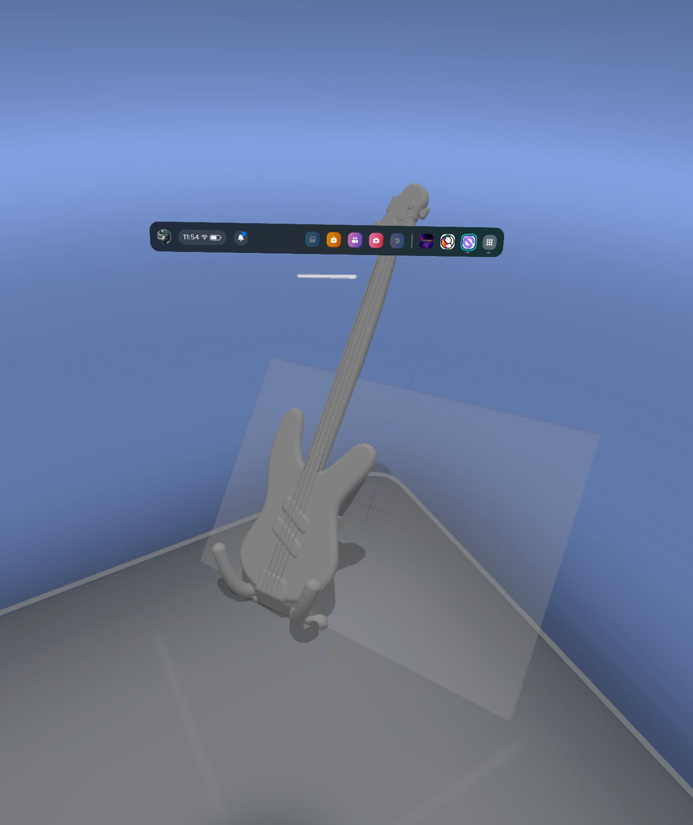
The last piece of software I looked at was Gravity Sketch, this app felt more focused on intricate 3D modelling and sketching than the previous two. I felt like if I had enough time and experience in the software I could build a complex, high-fidelity model.
The different tools in this app had a very high degree of customisation which helped in trying to create a quick 3D model of a bass guitar from memory. The process was intuitive enough to where, despite having very little experience in VR, I could create a recognisable shape from memory.
_______________________________________________________________________________________________________
Advantages and challenges of Immersive Design and VR
An advantage I observed during my experimentation with the software is that the ability to walk around or through creations helps understand the user’s spatial impact better than traditional 2D scenes.
In addition to that, for me the natural movement and freedom of VR encouraged experimentation without the constraints of conventional design interfaces.
On the other hand I also experienced things that could develop into potential challenges when working with this type of media. One of these challenges was adapting to the VR controls which definitely slowed down my initial workflow.
Also physical fatigue could me a major issue in this type of immersive design as I can imagine extended VR sessions may lead to discomfort which needs to be managed for sustainable work practices.